Dammer Bees Explained: India’s Wild Honey Makers of the Forests
Deep in India’s ancient forests, suspended from towering sal trees and dramatic cliff faces, lives a legendary honey producer known by many names—Dammer Bees, rock bee, cliff bee. Scientifically classified as Apis dorsata, these magnificent insects have fascinated honey hunters for centuries and produce what is considered the most prized wild forest honey in the subcontinent.
At Svastya Organic Farms, we honor the dammer bee as nature’s ultimate wild honey artisan—a species that reflects the raw, untamed spirit of India’s forests.
What Are Dammer Bees? Unveiling the Giant

The term dammer bee originates from regional Indian languages, where “dammer” translates to fierce or stinging—a fitting description of these powerful insects. Dammer bees are the giant honey bees of India, native to South and Southeast Asia and renowned for their size, strength, and defensive nature.
Physical Characteristics
-
Workers measure 17–20 mm, nearly twice the size of common honey bees
-
Dark brown to black bodies with golden-yellow abdominal bands
-
Powerful flight muscles enabling foraging distances of 5–7 km
-
Long proboscis to extract nectar from deep forest flowers
-
Highly aggressive defense to protect valuable honey stores
-
Exceptional pollen and nectar load-carrying capacity
Their large size allows access to diverse floral sources unavailable to smaller bees, resulting in nutrient-rich, complex wild honey with exceptional flavor depth.
The Dammer Bee’s Architectural Marvel

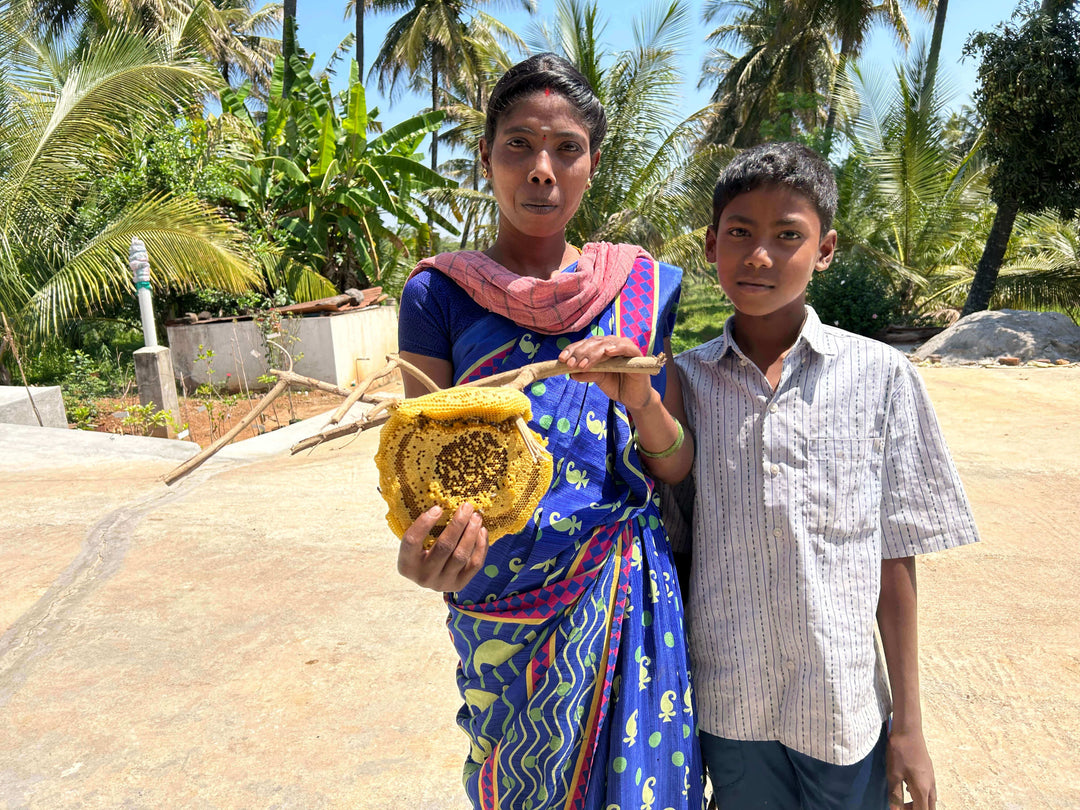
Unlike domesticated bees, dammer bees build a single massive exposed honeycomb—a breathtaking natural structure that can grow up to 1.5 meters long and house 30,000–100,000 bees.
Nesting Preferences
-
High tree branches 10–30 meters above ground
-
Rocky cliff overhangs offering partial shelter
-
Temple structures and abandoned rural buildings
-
Horizontal surfaces with clear flight paths
-
Areas near water sources and dense forest flora
-
Locations with shade and good air circulation
This open-comb architecture enables rapid temperature regulation, essential for brood development and honey maturation in tropical forest conditions.
The Sacred Migration: Following the Flowers

One of the most fascinating traits of dammer bees is their seasonal migration, making them truly nomadic honey producers. They move across regions in response to flowering cycles, ensuring access to diverse nectar sources.
Migration Cycle
Pre-Monsoon (March–May)
Colonies migrate to forests and higher elevations, feeding on mahua, mango, jamun, and wild blossoms while beginning honey accumulation.
Monsoon (June–September)
Bees seek sheltered nesting sites under cliffs. Foraging continues at a reduced pace using rain-season blooms.
Post-Monsoon (October–December)
Peak wild honey production period. Combs are heavy with mature honey—ideal for ethical harvesting.
Winter (January–February)
Colonies remain relatively stable, consuming stored honey while foraging on winter flora.
This migration ensures exceptional polyfloral diversity, making dammer bee wild honey rich in medicinal compounds.
Wild Honey: Liquid Gold of the Forests

Dammer bee wild honey is entirely untouched by agriculture or human intervention, making it one of nature’s purest sweeteners.
Exceptional Properties
-
Nectar from 50–100+ wild plant species
-
Higher enzyme activity (diastase and invertase)
-
Rich mineral content including iron, calcium, and magnesium
-
2–3× higher antioxidants than commercial honey
-
Strong natural antibacterial properties
-
Complex flavor—floral, woody, mildly bitter notes
-
Lower glycemic index for slower sugar absorption
In Ayurveda, dammer bee wild honey is traditionally used for respiratory health, digestion, wound healing, and immunity.
Traditional Honey Hunting: Ancient Wisdom and Courage

For thousands of years, indigenous communities have practiced the sacred craft of wild honey hunting, passing knowledge across generations.
Traditional Harvesting Methods
Timing and Preparation
Hunters study lunar cycles and bee behavior, preferring new moon nights when bees are calmer.
The Ascent
Trees and cliffs are climbed using ropes, bamboo ladders, or modern climbing gear—requiring immense skill and bravery.
Smoke Application
Natural smoke from neem leaves, herbs, or cow dung calms bees without harming them.
Sustainable Harvesting
Ethical hunters never destroy entire combs, always leaving brood sections intact for colony survival.
Collection and Processing
Honey is extracted naturally, filtered through cloth, and never heated—preserving enzymes and nutrients.
Conservation Challenges Facing Dammer Bees

Despite their resilience, dammer bees face growing threats:
-
Deforestation reducing nesting and foraging habitats
-
Pesticide exposure near forest edges
-
Climate change disrupting flowering cycles
-
Unsustainable honey harvesting
-
Urban expansion eliminating nesting sites
-
Competition from introduced bee species
At Svastya Organic Farms, we support conservation through reforestation, pesticide-free zones, and ethical sourcing partnerships.
The Svastya Commitment: Ethical Wild Honey
Our approach is rooted in sustainability, community respect, and authenticity.
Our Guarantees
-
100% wild-harvested from natural dammer bee colonies
-
Sustainable collection leaving enough honey for bees
-
Never heated above 35°C
-
Fair compensation for traditional honey hunters
-
Lab-tested for purity and adulteration
-
Traceable to forest regions and harvest seasons
Each jar carries a story of forests, people, and dammer bees creating true wild honey.
Conclusion: Guardians of Wild Sweetness
Dammer bees are more than honey producers—they are keystone forest pollinators, protectors of biodiversity, and symbols of India’s natural heritage. Their wild honey connects us to untouched ecosystems and ancient wisdom.
By choosing Svastya’s dammer bee wild honey, you support forest conservation, ethical livelihoods, and the survival of one of nature’s most extraordinary insects.
FAQs
1. Are dammer bees the same as rock bees?
Yes, dammer bees are commonly known as rock bees or cliff bees and are scientifically called Apis dorsata.
2. Is dammer bee wild honey safe to consume?
Yes, when sustainably harvested and properly tested, dammer bee wild honey is safe and highly nutritious.
3. Why is dammer bee honey more expensive?
It is rare, difficult to harvest, produced in small quantities, and sourced from wild forest ecosystems.