Why Traditional Wooden Cold Pressed Oils Leave Natural Residue at the Bottom
That Cloud at the Bottom of Your Oil Bottle
You open a new bottle of cold pressed coconut or groundnut oil and notice something unexpected — a soft, cloudy layer settled at the bottom. Or perhaps the oil itself appears slightly hazy, unlike the polished clarity of the refined oils you've used before.
Your first instinct might be doubt. Is this normal? Has the oil gone bad? Should I return it?
You're not alone. This is one of the most common questions asked by first-time buyers of traditional wooden cold pressed oils — and it deserves a proper answer.
The short version: that residue is not a flaw. It is a feature.
The longer version is a story about how real oil is made, what refining actually does to your food, and why a little cloudiness at the bottom of a bottle might be the best sign that what you've bought is the genuine article.
How Traditional Wooden Cold Pressed Oils Are Made

To understand the residue, you first need to understand the process.
Traditional wooden cold pressed oils — also called wood pressed oils or chekku oils in South India — are extracted using a method that has remained essentially unchanged for centuries. A large wooden press, called a ghani or chekku, slowly rotates and crushes the seeds or nuts under its own weight.
No heat is added. The oil that flows out is raw, unrefined, and alive in every sense — carrying the full spectrum of compounds that nature placed inside the seed. Because the process is slow and generates minimal friction heat (typically below 40°C), none of the heat-sensitive nutrients are destroyed in the process.
The result is an oil that looks, smells, and tastes like the ingredient it came from. Groundnut oil that genuinely smells of groundnuts. Sesame oil with that deep, round, nutty warmth. Coconut oil that carries the freshness of a just-opened coconut.
And yes — an oil that may have a little something settling quietly at the bottom.

What Causes Natural Residue in Cold Pressed Oils?
When seeds or nuts are crushed mechanically, the oil that emerges brings companions with it — microscopic particles that were part of the original ingredient.
These particles can include:
- Fine protein fragments from the seed kernel
- Natural plant waxes that are solid at room temperature
- Phospholipids — naturally occurring emulsifying compounds found in all plant seeds
- Tiny fibre particles from the seed's outer layer
- Natural colour pigments like chlorophyll or carotenoids
In a refined oil, all of these are systematically removed through degumming, bleaching, and filtration. The oil becomes uniform, transparent, and shelf-stable — but also stripped.
In a traditional cold pressed oil, many of these compounds remain. When the oil sits still — especially in cooler temperatures — they settle gently to the bottom. What you see as residue is, quite literally, the natural composition of the seed itself.
Why Unfiltered Oils May Retain More Nutrients
The compounds that form the residue in traditional wooden cold pressed oils aren't random impurities — many of them are nutritionally valuable.
Research published in peer-reviewed food science journals consistently shows that minimally processed, unfiltered cold pressed oils retain significantly higher concentrations of:
- Polyphenols — plant-based antioxidants that help protect cells from oxidative damage
- Tocopherols (Vitamin E) — fat-soluble antioxidants that support skin health and immune function
- Phospholipids — which support healthy cell membrane function and aid fat absorption
- Phytosterols — plant compounds associated with healthy cholesterol levels
(Source: NIH — Nutritional Quality of Cold Pressed vs Refined Vegetable Oils)
When oils are refined and filtered to achieve optical clarity, many of these compounds are removed along with the sediment. The oil looks cleaner — but the nutritional profile is considerably thinner.
Cloudiness, in this context, is not contamination. It is concentration.
⚖️ Refined Oils vs Traditional Wooden Cold Pressed Oils
| Feature | Traditional Wooden Cold Pressed Oils | Refined Oils |
|---|---|---|
| Extraction Method | Slow mechanical pressing (wooden ghani) | High-heat pressing or chemical solvent extraction |
| Temperature | Below 40°C — cold process | 150°C–200°C during processing |
| Chemicals Used | None | Often hexane, bleaching agents, deodorisers |
| Appearance | Slightly hazy or cloudy; may have sediment | Crystal-clear, uniform |
| Aroma | Natural, distinctive to the source seed | Mild or odourless after refining |
| Nutrient Retention | High — antioxidants, vitamins, polyphenols intact | Low — heat and processing degrade key nutrients |
| Natural Residue | Yes — normal and expected | No — removed through industrial filtration |
| Shelf Life | 6–18 months (naturally stable) | Longer (due to added preservatives/refining) |
| Ideal For | Daily cooking, skincare, traditional food use | Mass-scale commercial cooking |
| Overall Quality | Authentic, minimally processed | Standardised, processed |
Is the Residue Safe to Consume?
This is the question that matters most — and the answer is straightforward: yes.
The natural sediment found in traditional wooden cold pressed oils is composed entirely of food-derived particles. There are no synthetic additives, no microbial contamination (in a properly made and stored oil), and no industrial chemicals. You are looking at crushed seed particles in their natural state — nothing more.
In traditional Indian households, unfiltered oils were never considered inferior. On the contrary, they were considered more wholesome, more flavourful, and more effective — both in cooking and in Ayurvedic wellness practices. The residue was stirred in, not discarded.
It is important to note that residue in a properly stored, freshly produced oil is different from sediment caused by spoilage. A rancid oil will smell sharp, acrid, or unpleasant — that is the indicator to watch for, not the presence of natural particles.
How to Store and Use Oils With Natural Sediment
Traditional wooden cold pressed oils require a little more care than their refined counterparts — not because they're fragile, but because they're alive.
Follow these simple practices to get the most from your oil:
- Shake gently before use — this redistributes the natural sediment evenly through the oil, ensuring you use the full nutritional profile with each pour
- Store in a cool, dark place — away from direct sunlight and heat sources, which can accelerate oxidation
- Use a glass or ceramic bottle — if transferring from bulk packaging, always choose glass; plastic can interact with oil over time
- Keep it sealed — exposure to air is the primary cause of rancidity in any oil; always close the bottle tightly after use
- Use within the recommended window — unlike refined oils, traditional cold pressed oils have a natural shelf life; always check the production date and use within 6–12 months of opening
A slightly cloudy oil that smells clean and fresh is a well-made oil. Trust your nose — it is the most reliable quality indicator you have.
The Cloudiness Is the Credential
In a world of polished, perfected, uniformly clear products, a little natural cloudiness can feel unsettling. We've been conditioned to equate clarity with cleanliness and transparency with quality.
But with traditional wooden cold pressed oils, the reverse is often true. That soft haze, that gentle layer of natural sediment — it is the oil telling you exactly what it is. Unrefined. Unfiltered. Unapologetic.
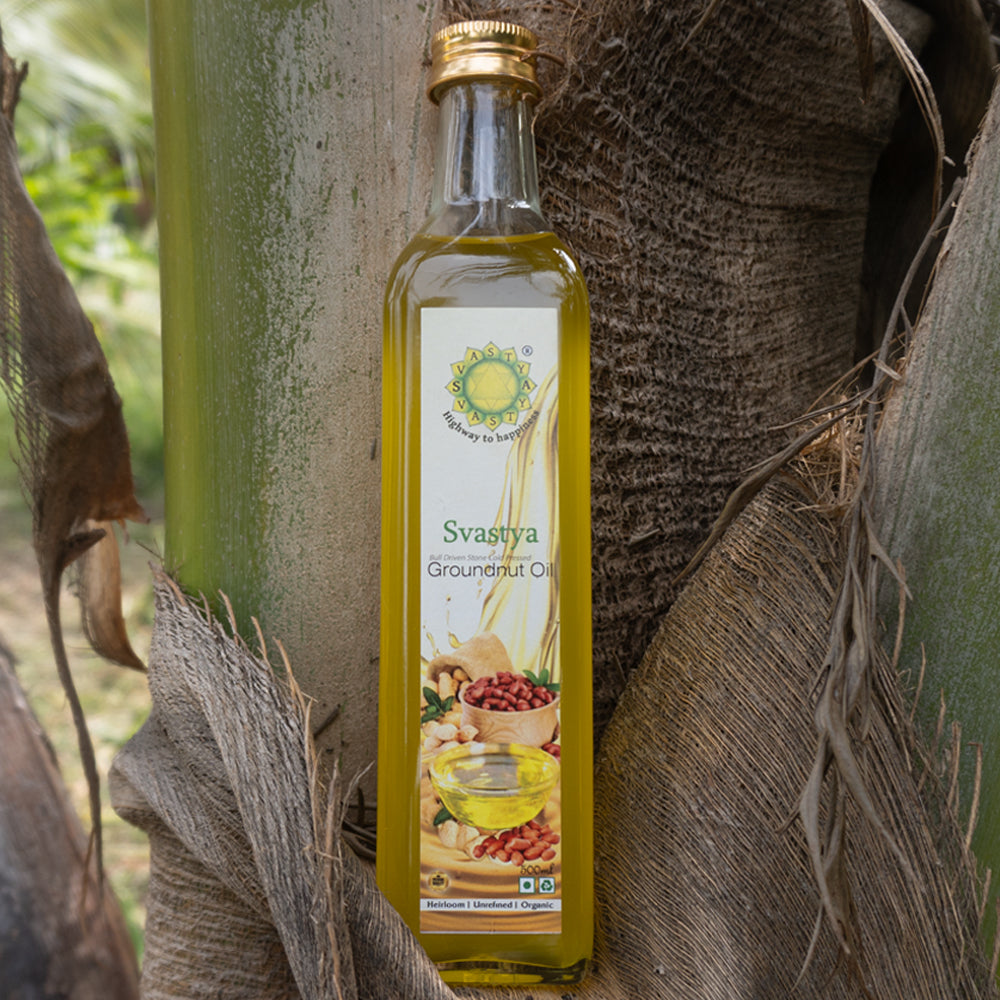
At Svastya Organic Farms, our cold pressed oils are made the way they always have been — slowly, carefully, and without shortcuts. If your bottle has a little residue resting at the bottom, consider it a signature. A mark of authenticity that no refined, industrial oil can replicate.
FAQs: Traditional Wooden Cold Pressed Oils and Natural Residue
Q1. Why do traditional wooden cold pressed oils leave residue at the bottom?
The residue in traditional wooden cold pressed oils consists of microscopic seed particles — proteins, natural waxes, phospholipids, and plant fibres — that remain in the oil after mechanical pressing. Because these oils are not industrially filtered or refined, these particles settle naturally at the bottom. This is completely normal and is a sign of minimal processing, not poor quality.
Q2. Is sediment in cold pressed oil normal and safe to consume?
Yes — entirely. The natural sediment in a traditional wooden cold pressed oil is composed of food-derived plant particles. It contains no synthetic chemicals, no microbial contamination, and no harmful substances. In traditional Indian cooking and Ayurvedic practice, unfiltered oils with natural sediment were considered the most wholesome form of the ingredient. Simply shake gently before use to incorporate the settled particles.
Q3. Are unfiltered cold pressed oils healthier than filtered refined oils?
Generally, yes. Research consistently shows that unfiltered cold pressed oils retain higher concentrations of polyphenols, Vitamin E, phytosterols, and phospholipids than refined oils — many of which are removed during industrial filtration and processing. The wood pressed oil benefits you read about — better flavour, richer nutrition, higher antioxidant content — are directly tied to this minimal processing approach.
Q4. How should I store traditional cold pressed oils with natural sediment?
Store your oil in a cool, dark place — away from sunlight and heat. Always keep the bottle tightly sealed. Shake gently before each use to distribute the natural sediment. Use within 6–12 months of opening for the best flavour and nutritional quality. For a full range of properly stored traditional edible oils, explore the Svastya Organic Farms collection.