Glass Bottles vs Plastic Bottles: Does Packaging Affect Oil Quality?
The One Thing Most Buyers Forget to Check
You read the label carefully. You look for "cold-pressed" and "chemical-free" and "100% organic." You choose the brand with the cleanest ingredient list and the most transparent sourcing story. And then the oil comes home — in a plastic bottle. Packaging isn't just a container. It's the oil's entire environment from the moment it's bottled to the moment it reaches your kitchen. And that environment matters far more than most people realise.
Why Packaging Matters More Than You Think

Edible oils are living, reactive substances. They contain fatty acids, antioxidants, polyphenols, and volatile aromatic compounds — all of which are sensitive to their surroundings.
Three environmental factors can quietly degrade oil quality:
- Light — UV and visible light accelerate oxidation, breaking down antioxidants and causing rancidity
- Heat — elevated temperatures speed up chemical reactions, including the breakdown of unsaturated fatty acids
- Oxygen and permeability — any packaging material that allows oxygen in, or leaches chemicals out, compromises the oil's integrity
Glass handles all three of these threats far better than plastic. But let's look at why — side by side.
⚖️ Glass Bottles vs Plastic Bottles for Oil Storage
| Feature | Glass Bottles | Plastic Bottles |
|---|---|---|
| Chemical Reactivity | Inert — does not react with oil | Can leach BPA, phthalates, or antimony into oil |
| Oxygen Permeability | Zero — fully impermeable | Low but measurable oxygen transmission over time |
| Heat Resistance | High — stable across temperatures | Can soften, warp, and accelerate leaching when warm |
| UV Protection | Excellent (amber/dark glass) | Poor — most plastic is transparent to UV |
| Effect on Flavour | None — preserves natural aroma | Can impart a faint plastic taste over time |
| Shelf Life Preservation | Superior | Reduced, especially in warm climates |
| Food-Safety Record | Centuries of safe use | Variable — depends on plastic grade and additives |
| Environmental Impact | Recyclable, reusable indefinitely | Single-use; microplastic concerns |
| Premium Perception | High — signals quality and care | Lower — associated with mass-market products |
| Best For | Cold-pressed, virgin, and artisanal oils | Short shelf-life, low-value commodity oils |
Heat, Sunlight, and Storage: The Silent Destroyers
Imagine your bottle of oil sitting in a delivery truck in May. Or on a warehouse shelf under fluorescent lighting for three weeks. Or in a kitchen cabinet next to a stove.
In a plastic bottle, each of these scenarios carries a compounding risk.
Plastic packaging — particularly PET (polyethylene terephthalate), which is used for most food-grade bottles — begins to show signs of chemical migration at temperatures above 60°C. In Indian summers, enclosed spaces like cars or courier bags can easily reach these temperatures.
Research has shown that even food-grade plastic bottles used for edible oils can release trace compounds such as acetaldehyde and other volatile organic compounds (VOCs), particularly when stored warm or for extended periods. (Source: Journal of Food Science via NIH)
Glass doesn't change. It doesn't warp. It doesn't release anything. Whether it's stored in a cold pantry or transported through a scorching summer, an amber glass bottle maintains its structural integrity and keeps the oil inside exactly as it was when it was bottled.
The Concern With Plastic Packaging
To be clear: not all plastic is dangerous, and reputable brands use food-grade, BPA-free plastic that meets regulatory standards.
But the concern isn't only about BPA.
A growing body of research has drawn attention to a broader class of substances — collectively called endocrine-disrupting chemicals (EDCs) — that can migrate from plastic packaging into food. Some phthalates (plasticisers used to make plastic more flexible) and UV stabilisers used in plastic production have been flagged as potential EDCs in food packaging. (Source: National Institutes of Health — Food Packaging & Chemical Migration)
For most foods, the risk is negligible. But oils are different.
Because oils are fat-soluble, they are particularly effective at dissolving and absorbing fat-soluble chemicals. If any compound migrates from the plastic container into an oil — even in trace amounts — the oil will carry it all the way to your body. This is a concern that applies specifically to fatty foods stored in plastic, not to water or dry goods.
Why Glass Is the Right Choice for Premium Oils
Glass has been used to store food and medicine for thousands of years — and for good reason.

Here's what makes glass the preferred packaging for genuinely premium edible oils:
- Chemically inert — glass does not react with oil under any condition, hot or cold
- Zero permeability — no oxygen, no moisture, no external compounds can pass through
- Light-blocking — amber and dark glass filter out UV rays that cause oxidative rancidity
- Flavour-neutral — oil tastes exactly as it should, with no off-notes from the container
- Reusable — a glass bottle can be cleaned and repurposed, reducing household waste
- Trust signal — for health-conscious consumers, glass communicates care, quality, and transparency
For a premium edible oil that has been cold-pressed, traditionally extracted, and carefully crafted to preserve its nutrients — using anything less than glass packaging would be a contradiction.
Sustainability: Glass vs Plastic in the Bigger Picture
Beyond what's in the bottle, there's the question of what happens to the bottle after you're done with it.
Plastic packaging is recycled at dismally low rates globally — and most single-use plastic bottles end up in landfill or, worse, in natural ecosystems where they break down into microplastics over hundreds of years. Microplastics have now been detected in human blood, lung tissue, and even breast milk. The scale of this problem is only beginning to be understood.
Glass, by contrast, is:
- 100% recyclable — indefinitely, without degradation in quality
- Reusable — the same bottle can serve multiple purposes in your home
- Inorganic — it does not break down into harmful particles in the environment
- Carbon-neutral-capable — when produced with renewable energy, glass has a significantly lower long-term environmental footprint than plastic
Choosing glass isn't just a personal health decision. It's a statement about the kind of consumption you want to participate in.
The Bottle Is Part of the Product
When you invest in a truly premium oil — one that has been grown without chemicals, extracted without heat, and bottled without shortcuts — the packaging is not an afterthought. It is the final act of care.
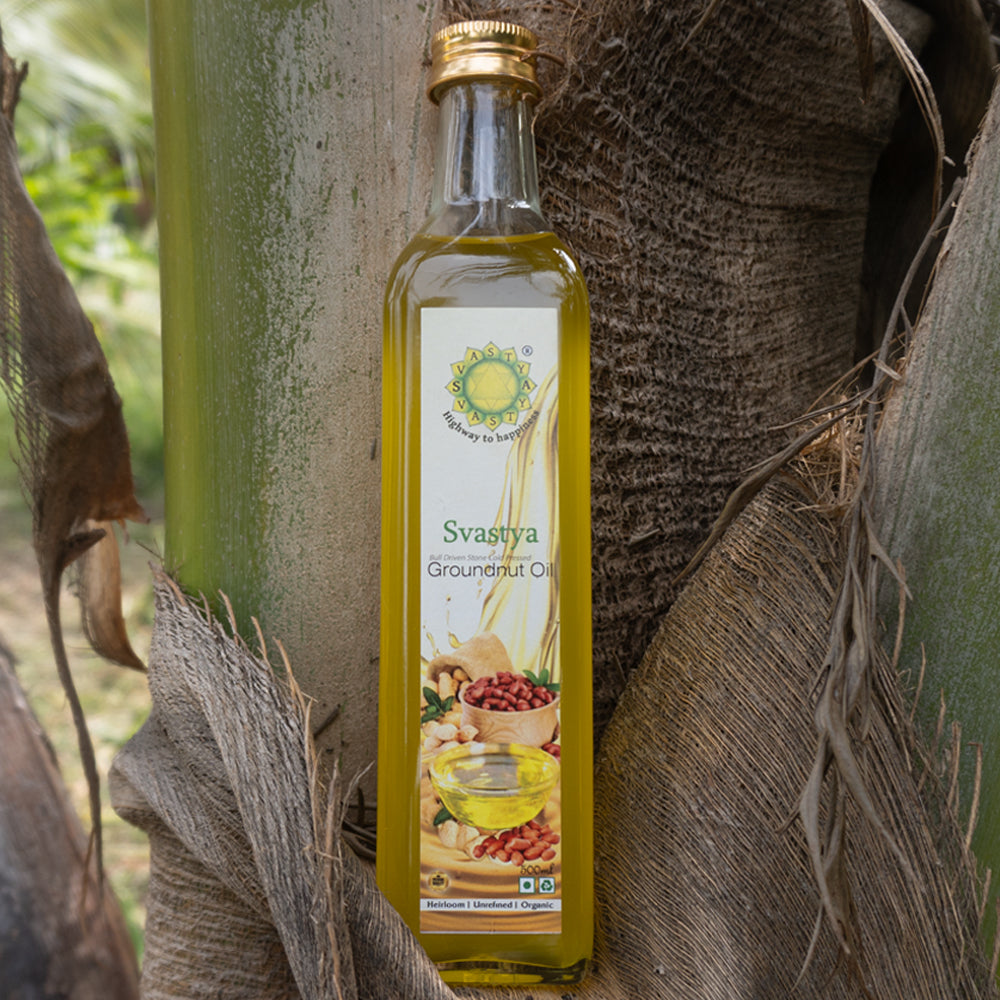
At Svastya Organic Farms, we believe that a traditionally made oil deserves packaging that protects it. That means glass — not because it looks better on a shelf (though it does), but because it's the only honest choice for an oil you've worked this hard to make pure.
FAQs: Glass Packaging vs Plastic for Edible Oils
Q1. Is glass packaging really better than plastic for storing oils?
Yes. Glass is chemically inert and impermeable, meaning it doesn't interact with the oil, doesn't allow oxygen in, and doesn't transfer any compounds. Plastic packaging — even food-grade — can allow trace chemical migration, especially in warm conditions. For premium oils like traditional coconut oil, glass is the only option that fully preserves quality.
Q2. Can plastic actually affect oil quality?
It can. Edible oils are fat-soluble, which means they are more likely than water to absorb fat-soluble chemical compounds that migrate from plastic over time. This is especially true when oil is stored warm, exposed to light, or kept in plastic for extended periods. The effect may be subtle, but it is measurable — both in flavour and in nutrient retention.
Q3. Why do premium brands choose glass bottles for their oils?
Glass protects the oil from light (especially amber glass), oxygen, heat, and chemical contamination — all of which are the enemies of a high-quality edible oil. Premium brands that invest in traditional extraction and careful sourcing choose glass because it's the only packaging that respects the integrity of what's inside.
Q4. Does packaging affect the shelf life of oil?
Absolutely. Oil stored in glass has a demonstrably longer effective shelf life than the same oil in plastic, because glass prevents oxidation, blocks UV light (when coloured), and maintains a stable internal environment. Proper glass packaging can extend the useful life of a premium cold-pressed oil by several months compared to plastic storage.