Groundnut Oil vs Mustard Oil: Which Bull Driven Oil is Best for Indian Cooking?
Few things define an Indian kitchen quite like the oil it cooks in. Ask a home cook from Rajasthan and they will swear by the fiery depth of mustard oil. Ask someone from Gujarat or Tamil Nadu and the gentle warmth of groundnut oil is non-negotiable. These are not merely preferences — they are culinary identities, shaped by generations of tradition, regional agriculture, and an instinctive understanding of how food should taste and nourish.
Today, as more households choose to move away from refined industrial oils and return to traditional cooking oils, the question of groundnut oil vs mustard oil comes up naturally. Which is healthier? Which is better for which dish? And crucially — when both are extracted the traditional bull driven way, does the choice really matter?
This guide explores both oils honestly and warmly — not to declare a winner, but to help you understand which oil, or combination of oils, is right for your kitchen, your cuisine, and your family.
What Are Bull Driven Oils? The Foundation of Authentic Extraction

Before comparing the two oils, it is worth understanding what makes a bull driven oil different from everything else on the supermarket shelf.
The traditional wooden ghani — known as chekku in the South, kolhu in the North, and ghani across much of India — is an ancient pressing system. Raw seeds are placed in a large wooden mortar, and a bullock harnessed to a long beam walks in patient, steady circles, turning the pestle and gradually crushing the seeds. Oil emerges slowly, at ambient temperature — typically between 25°C and 45°C — without the application of external heat or chemicals.
This slow, gentle process is why bull driven oil retains what refined oil cannot: natural vitamins, antioxidants, unbroken fatty acid chains, and the genuine aroma of the seed it came from. Nothing is added. Nothing meaningful is removed. What you get in the bottle is what the seed always contained.
The ghani does not rush. And in that patience, it preserves everything the seed spent months producing — something no industrial press, however powerful, can claim to replicate.
Groundnut Oil vs Mustard Oil — Understanding the Basics

- Pressed from shelled, dried groundnuts (peanuts)
- Mild, pleasantly nutty flavour with gentle sweetness
- Pale golden colour — rich aroma when cold pressed
- Dominant in South India, Maharashtra, Gujarat, and Andhra Pradesh
- Suited to frying, tempering, curries, chutneys, and sweets
- Traditional foundation of South Indian and West Indian cooking

- Pressed from brown or yellow mustard seeds
- Distinctively sharp, pungent flavour and strong aroma
- Deep amber colour — bold character even in small quantities
- Dominant in Punjab, Bengal, Odisha, Bihar, and Uttar Pradesh
- Essential for pickles, fish, mustard-based gravies, and bhuna dishes
- Traditional cornerstone of North and East Indian cooking
Benefits of Bull Driven Groundnut Oil
Cold pressed groundnut oil is perhaps the most universally versatile traditional cooking oil in India. Mild enough not to overpower delicate flavours, yet rich enough to carry deep, complex spice profiles — it is the quiet workhorse of the traditional Indian kitchen.
What makes bull driven groundnut oil exceptional?
When extracted through the wooden ghani, groundnut oil retains its natural Vitamin E, resveratrol, and monounsaturated fatty acids — compounds that support heart health, reduce inflammation, and protect the oil's own stability during cooking. Its natural smoke point, while lower than highly refined versions, is perfectly suited for South Indian tempering, medium-heat curries, and everyday frying.
The flavour is its own reward. A drizzle of cold pressed groundnut oil into a hot pan releases a warm, toasty, deeply satisfying aroma that refined groundnut oil — stripped of its volatile compounds — simply cannot replicate. Traditional chutneys, peanut-based curries, and Maharashtra-style gravies cooked in chekku groundnut oil carry a depth that is immediately recognisable to anyone who grew up with it.
Best for: South Indian sambar and rasam, Maharashtrian gravies, Gujarati shaak, stir-fried vegetables, traditional namkeen and snacks, everyday tempering and daily cooking.
Benefits of Bull Driven Mustard Oil
Cold pressed mustard oil is bold in a way that very few cooking ingredients are. Its pungency is not a flaw — it is the entire point. In North and East Indian cooking, mustard oil is the flavour architect: it builds the base of a dish's character before a single spice has been added.
What makes bull driven mustard oil exceptional?
Traditionally extracted mustard oil retains its full array of glucosinolates, allyl isothiocyanates (the compound responsible for its signature heat), omega-3 fatty acids, and natural antioxidants. These compounds, destroyed or reduced in the refining process, are what give cold pressed mustard oil its Ayurvedic reputation as a warming, circulatory-stimulating, and digestive oil.
In Ayurvedic tradition, mustard oil is considered ushna (heating) and tikshna (penetrating) — qualities prized for supporting circulation, warming the body in colder months, and aiding in the breakdown of heavy foods. Applied externally, it has long been used in winter body massage across the subcontinent.
For cooking, a traditional technique used across North India is to heat mustard oil gently until it begins to smoke slightly — a brief moment that mellows its raw sharpness and opens up its deeper, rounder notes before spices are added.
Best for: Bengali fish curry and aloo posto, Punjabi sarson ka saag, pickles and achaar, Bihari litti chokha, mustard-marinated proteins, and any dish where bold, assertive flavour is the foundation.
Groundnut Oil vs Mustard Oil — Which Is Better for Indian Cooking?
The most honest answer is: it depends on what you are cooking and where your culinary roots lie. Here is a balanced breakdown to guide your choice.
| Parameter | 🥜 Groundnut Oil | 🌿 Mustard Oil |
|---|---|---|
| Flavour | Mild, nutty, gentle warmth — won't overpower dishes | Bold, pungent, sharp — defines the dish's character |
| Aroma | Light, pleasant, toasted peanut fragrance | Strong, unmistakable, intensifies with heat |
| Best cuisine | South Indian, Maharashtrian, Gujarati, everyday cooking | Bengali, Punjabi, Bihari, Odishan, North & East Indian |
| Frying | Excellent — stable, mild, widely preferred for snacks and pakoras | Good — heat first to reach smoke point for best results |
| Pickles & achaar | Usable, though less traditional in pickle making | Outstanding — the traditional and preferred choice for Indian pickles |
| Key nutrients | Vitamin E, resveratrol, monounsaturated fats, Omega-6 | Omega-3, glucosinolates, allyl isothiocyanate, Vitamin E |
| Ayurvedic quality | Snigdha (nourishing), balancing, easy to digest | Ushna (warming), tikshna (penetrating), circulatory |
| Daily use | Ideal for everyday cooking across most households | Excellent where bold flavour is desired; moderate use otherwise |
The real insight here is that choosing between these two oils is not about finding the objectively "better" one — it is about understanding your own kitchen. Many experienced Indian cooks keep both: groundnut oil for everyday cooking and delicate dishes, mustard oil for pickles, regional specialties, and bold preparations. That combination represents the full breadth of Indian culinary tradition.
Why Bull Driven Oils Are Better Than Refined Alternatives
Whether you choose groundnut or mustard, the extraction method matters enormously. Here is why the traditional bull driven approach consistently delivers superior results.
No Damaging Heat
Industrial extraction reaches 120–200°C. The ghani works at ambient temperature — preserving every delicate compound in the seed.
Zero Chemical Solvents
No hexane, no bleaching agents, no deodorisers. The oil that leaves the ghani is the same oil that enters the seed.
Full Nutrient Profile
Vitamins, antioxidants, natural fatty acids, and phytonutrients survive extraction intact — not stripped away then partially replaced.
Authentic Aroma & Taste
The flavour compounds destroyed in refining are what make each oil distinct. In bull driven oils, they are fully present and undiminished.
Supports Traditional Artisans
Choosing ghani oil directly sustains the livelihoods of traditional oil press operators and rural farming families across India.
Environmentally Mindful
Animal-powered extraction uses no electricity and generates no industrial chemical waste — a food system that is gentle on the earth.
How to Choose Authentic Bull Driven Oils — What to Look For
The growing popularity of traditional oils has brought with it a market full of products that claim traditional extraction without the substance behind it. Here is how to identify the genuine article.
-
Trust your nose first. Authentic cold pressed groundnut oil smells of warm, toasted peanuts. Real mustard oil has an unmistakable, pungent sharpness. If the oil smells of nothing, it has been deodorised — and with the aroma, much of the nutritional value has gone too.
-
Colour is your second guide. Cold pressed groundnut oil is pale to rich golden, never water-clear. Bull driven mustard oil is deep amber to brownish-gold — never the pale yellow of heavily refined versions.
-
Sediment is a sign of authenticity. A small amount of natural sediment or cloudiness in the bottle means the oil has not been stripped through commercial filtering. Shake gently before use.
-
Read the label honestly. Look for explicit claims: "wooden ghani pressed," "bull driven," "cold pressed — no solvent," "single extraction." Vague terms like "natural" or "traditional" without specifics deserve scrutiny.
-
Ask about sourcing. A brand that knows which farms its seeds come from, which pressing artisans it works with, and which region the seeds were grown in is a brand that takes the process seriously. Svastya names its sources because we believe you have the right to know.
-
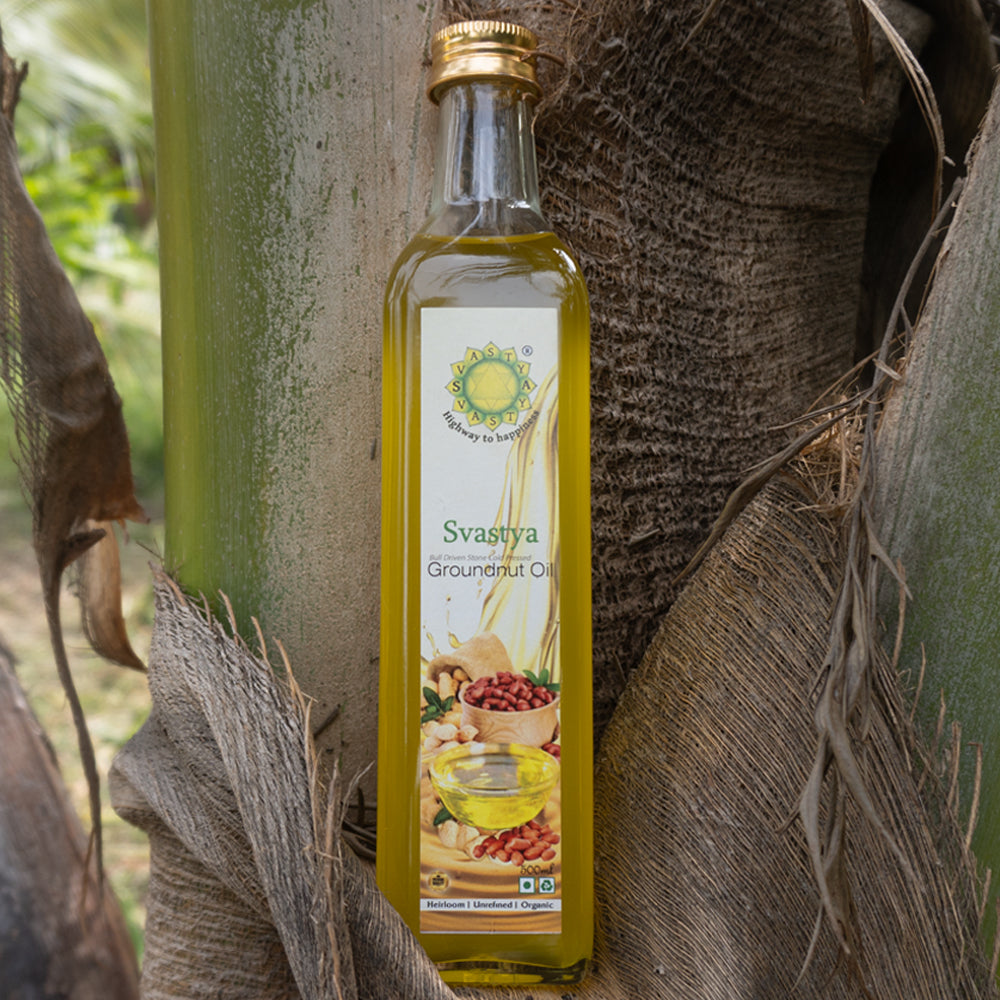
Glass, not plastic. Unrefined oils stored in glass are protected from light, heat, and chemical leaching. Premium traditional oils deserve premium packaging — and so does your family's health.
The Real Answer to Groundnut Oil vs Mustard Oil
The question of groundnut oil vs mustard oil is ultimately not a competition. It is an invitation to understand two of India's most magnificent culinary traditions — and to appreciate why the method of extraction is as important as the oil itself.
Choose groundnut oil for its gentle versatility, its everyday warmth, and its quiet ability to let ingredients speak for themselves. Choose mustard oil for its fierce character, its regional soul, and its deep-rooted place in the kitchens of North and East India. Choose both, if your cooking moves across these traditions.
But above all, choose the bull driven version of whichever you use. Because when the ghani does the pressing — slowly, patiently, without compromise — what you bring home is not just cooking oil. It is the full expression of what the seed was always meant to give: nutrient-rich, chemical-free, and carrying in every drop the ancient wisdom of Indian wellness.
That is what conscious cooking looks like. And it has never tasted better.
Frequently Asked Questions
1. Which is better for Indian cooking- groundnut oil or mustard oil?
Both are excellent traditional cooking oils — the choice depends on your regional cuisine and flavour preference. Groundnut oil is mild, versatile, and ideal for everyday cooking, frying, and South and West Indian dishes. Mustard oil is bold and pungent, essential for North and East Indian recipes, pickles, and strongly flavoured preparations. Many experienced Indian cooks keep both in the kitchen.
2. What is bull driven oil and how is it different from refined oils?
Bull driven oil is extracted using a traditional wooden ghani press powered by a bullock walking slowly in circles. This low-temperature, chemical-free process preserves the oil's natural nutrients, aroma, and flavour. Refined oils are made using high heat (120–200°C), chemical solvents like hexane, and multiple processing stages — all of which strip away beneficial compounds. The result is an oil that looks cleaner but is nutritionally far inferior.