Full Moon Ghee: Myth or Superfood? Everything You Need to Know
Full moon ghee has been quietly trending across wellness circles — and with it, a flurry of questions. Is it a genuine superfood with ancient roots? Or a smart repackaging of traditional ghee with a romantic name attached?
The honest answer sits somewhere in the middle — and understanding it will help you make a far better decision the next time you reach for a jar of ghee. Let's get into it.
What is full moon ghee?
Full moon ghee — also called Purnima ghee — is traditional cultured ghee whose preparation is intentionally timed to the full moon cycle. At its core, it is made from the curd of A2 milk sourced from indigenous cows, hand-churned using the traditional bilona method, and slow-cooked to golden clarity.
The "full moon" element refers to when the ghee is made or finished — typically on or around Purnima night. Some producers also expose the finished ghee to open moonlight overnight, a practice rooted in classical Ayurvedic tradition called Chandra Siddhi.
It is not a different recipe. It is the same authentic process — held to a different rhythm.
Where did the idea of full moon ghee come from?
The practice is far older than modern wellness culture. Ayurveda — India's classical system of medicine — has long recognised the influence of lunar cycles on the human body, on tidal rhythms, on plant growth, and on fermentation.
The full moon (Purnima) was considered a time of peak sattvic energy in nature — a quality associated with clarity, harmony, and nourishment. Foods prepared or stored under this influence were believed to absorb these qualities, making them more calming, more potent, and more easily assimilated by the body.
Classical Ayurvedic texts such as the Charaka Samhita mention the use of lunar cycles in preparing medicinal formulations. This is not mysticism — it is a sophisticated, pre-scientific framework for understanding natural rhythms that modern chronobiology is only beginning to explore. Read about Ayurvedic ghee preparation (NCBI).
How full moon ghee is made

The process is identical to traditional cultured bilona ghee — which is already one of the most nutritionally rich forms of ghee available:
- Fresh A2 milk from indigenous cow breeds is gently boiled and cooled
- The milk is cultured overnight into curd using a natural starter from the previous batch
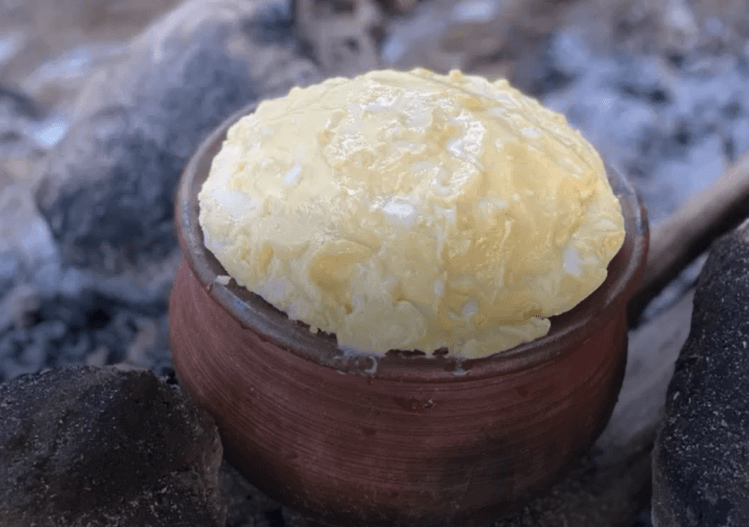
- The curd is hand-churned using a traditional wooden bilona in a two-directional motion to extract fresh white butter
- The butter is slow-cooked on a low flame until it clarifies into fragrant, golden ghee
- In full moon ghee, this process is timed so the final cooking or resting coincides with Purnima night
It takes roughly 25–30 litres of milk to yield just one litre of ghee this way. There are no shortcuts, no additives, and no industrial machinery involved.
Full moon ghee: claimed benefits
Most of the benefits attributed to full moon ghee are actually the well-established benefits of high-quality cultured bilona ghee — which is, in itself, a genuinely nourishing food.
Supports gut health
Cultured ghee is one of the richest natural sources of butyric acid — a short-chain fatty acid that feeds the colon's cell lining, reduces inflammation, and supports microbiome balance. Research links dietary butyrate to improved gut barrier function (NCBI).
Aids digestion
Ayurveda prescribes ghee as the primary food for kindling agni — digestive fire. It lubricates the intestinal tract, stimulates enzyme production, and eases bloating, constipation, and sluggish digestion. This is consistent with what modern nutritional science understands about fat's role in digestion.
Mental calm and clarity
In Ayurveda, ghee is considered deeply sattvic — a food that promotes mental clarity, emotional balance, and calm. Whether this is a direct neurological effect of butyrate and fat-soluble vitamins, or a broader mind-body phenomenon, many regular consumers report a noticeable sense of grounded nourishment.
Nutritional richness
Authentic full moon ghee — being a cultured A2 bilona ghee — is naturally high in Vitamins A, D, E, and K2, as well as conjugated linoleic acid (CLA), which has documented anti-inflammatory properties.
These benefits come from the quality of the process and milk — not from the lunar timing alone. A poorly made ghee labelled "full moon" will not deliver these outcomes. Always look behind the label.
Myth vs reality: what does the science actually say?
Full moon ghee has unique healing powers that no other ghee can match.
The benefits come from A2 milk and the bilona process. Lunar timing carries traditional and cultural significance — not a verified chemical advantage.
Any ghee with a "full moon" label is automatically premium and worth a steep premium price.
Quality depends entirely on milk source, cow breed, and preparation method. The label means nothing without transparency about these fundamentals.
The full moon concept is pure modern marketing with no traditional basis.
Lunar-aligned food preparation has genuine roots in Ayurveda and Indian tradition — it predates the wellness industry by thousands of years.
Full moon ghee vs regular ghee

If both are made via the authentic bilona method from A2 milk, the nutritional profile of full moon ghee and traditionally made cultured ghee will be nearly identical. The full moon timing adds cultural depth and intentionality — qualities that many people find meaningful, but that are not measurably different in a lab test.
What creates a clear, measurable difference is the comparison between any authentic cultured bilona ghee and commercially produced regular ghee made from cream. That gap — in butyrate, CLA, digestibility, and flavour — is significant and well-documented.
What actually matters when choosing ghee
These three factors will tell you far more about the quality of a ghee than any label — full moon or otherwise. Ask for them. Expect them. Any brand worth trusting will provide them freely.
Why Svastya's ghee stands out


At Svastya Organic Farms, we don't follow wellness trends. We follow traditions. Our cultured ghee is made from A2 milk sourced directly from indigenous Gir and Sahiwal cows raised on open, chemical-free pastures — traceable from cow to jar.
Every batch is hand-churned by women artisans from rural farming communities who have practised the bilona method across generations. These are not employees following a process manual. They are custodians of a living tradition.
Whether or not you subscribe to the significance of the full moon, we believe the most powerful thing in the jar is honesty — about the milk, the method, and the people who made it.
FAQs
1. Is full moon ghee actually better than regular ghee?
Compared to commercially made regular ghee — yes, significantly. Full moon ghee is a cultured bilona ghee made from A2 milk, which means it carries far more butyric acid, CLA, and fat-soluble vitamins than cream-based commercial ghee. Compared to another high-quality cultured bilona ghee made without lunar timing, the nutritional difference is minimal. The full moon element adds cultural and traditional significance, which many people genuinely value — but the measurable quality advantage comes from the process and the milk, not the moon.
2. Does the full moon actually affect ghee quality?
Modern science has not conclusively proven that lunar timing changes the chemical composition of ghee. What Ayurveda does propose — and what emerging research in chronobiology begins to explore — is that natural rhythms, including lunar cycles, do influence fermentation, biological systems, and food preparation in subtle ways. We present the full moon connection as a meaningful traditional practice rooted in Ayurvedic knowledge, not as a clinically verified enhancement. The honest position is: we don't fully know, and anyone claiming certainty in either direction should be questioned.
3. How can I identify authentic traditional ghee?
Authentic cultured bilona ghee — full moon or otherwise — has several reliable markers: a grainy or slightly crystalline texture at room temperature, a deep golden-amber colour, a rich nutty aroma with subtle complexity, and a flavour that is noticeably more layered than commercial ghee. On the label, look for clear mention of A2 milk, bilona or hand-churning process, and the specific cow breed. Most importantly, the brand should be transparent about their farm source and production method. If that information is absent or vague, treat the label with scepticism.