Why Authentic Cold Pressed Oils Have a Shorter Shelf Life
Walk into any supermarket and pick up two bottles of edible oil — one refined, one cold pressed. The refined oil will stay on your shelf for two years or more. The cold pressed one might carry a six to twelve month window from its production date. Understanding the shelf life of cold pressed oils means understanding what those oils still contain — and why that fullness comes with a natural expiry.
Most people, without thinking, assume the longer-lasting one is better. It isn't.
What keeps that refined oil stable for two years is not superior quality. It is a carefully engineered absence of everything that makes oil nutritious in the first place — antioxidants removed, volatile compounds stripped, and in many cases, synthetic antioxidants or preservatives added back in to slow the oxidation that refining itself accelerates.
What Makes an Oil Truly Cold Pressed?

Authentic cold pressed oils are extracted from seeds, nuts, or grains using slow mechanical pressing — with no external heat, no chemical solvents, and no post-extraction refining. The process preserves the oil's full natural profile:
- Its native antioxidants and polyphenols
- Fat-soluble vitamins like Vitamin E and carotenoids
- Natural phospholipids and plant sterols
- Flavour compounds and volatile aromatics that give each oil its characteristic taste and smell
- Trace moisture and organic particles from the source seed
This is oil as close to its natural state as it can be — and that's precisely the point. Every compound listed above serves a purpose in the human body. Every one of them is also, to varying degrees, sensitive to time, heat, light, and oxygen.
That sensitivity is not a weakness of the oil. It is evidence of its integrity.
Why Natural Oils Have a Shorter Shelf Life
The shelf life of cold pressed oils is governed by a process called oxidation — the gradual reaction between the oil's fatty acids and oxygen in the surrounding air.
All oils oxidise over time. The difference is in how fast, and what accelerates it.
In authentic cold pressed oils, oxidation happens naturally because:
The oil still contains active compounds. Natural antioxidants like Vitamin E and polyphenols slow oxidation — but they do so by sacrificing themselves, gradually depleting as they neutralise free radicals. Once they're used up, the oil becomes more susceptible.
There are no synthetic preservatives. Commercial refined oils often contain added synthetic antioxidants — such as BHA (butylated hydroxyanisole) or TBHQ (tert-butylhydroquinone) — which significantly extend shelf stability. Authentic oils carry none of these.
Trace moisture from the seed remains. In unrefined oils, tiny amounts of natural moisture from the source seed can remain in the oil, which — over time — can contribute to hydrolytic rancidity, another pathway of degradation.
None of this means the oil is poorly made. It means the oil is honest.
The Role of Refining and Preservatives in Commercial Oils
To appreciate why cold pressed oils expire faster, it helps to understand what the alternative actually involves.
Refined oils undergo a multi-stage industrial process:
- Degumming — removes phospholipids and gums
- Neutralisation — strips free fatty acids using alkali
- Bleaching — removes colour pigments and trace metals
- Deodorisation — uses steam at 200°C+ to remove aroma compounds
- Winterisation — removes waxes to ensure the oil stays clear when cold
By the end of this process, what remains is a chemically uniform, flavourless, colourless oil that is highly stable — because there is very little left in it that can react. Many refined oils then have synthetic antioxidants added back in specifically to extend shelf life further.
The result is an oil that lasts two years. It also happens to be an oil that has been largely emptied of the nutritional richness that made it worth pressing in the first place.
(Source: Healthline — Refined vs Unrefined Oils: What's the Difference?)
⚖️ Authentic Cold Pressed Oils vs Refined Oils
| Feature | Authentic Cold Pressed Oils | Refined Oils |
|---|---|---|
| Extraction Process | Slow mechanical pressing, no heat | High-heat pressing or solvent extraction |
| Refining | None — minimally processed | Multi-stage industrial refining |
| Preservatives Added | None | Often BHA, TBHQ, or other synthetics |
| Antioxidant Content | High — naturally present | Low — removed during refining |
| Vitamin E Retention | Fully retained | Largely degraded or removed |
| Natural Aroma | Distinctive, seed-true | Mild or neutral (stripped out) |
| Colour | Natural — golden, amber, or dark | Pale, uniform (bleached) |
| Shelf Life | 6–12 months (natural) | 18–24 months+ (with additives) |
| Residue / Sediment | May be present (natural) | None (industrially filtered) |
| Overall Nutritional Value | Higher — full-spectrum nutrients | Lower — processed nutrients |
How to Recognise Authentic, Minimally Processed Oils
A shorter shelf life is just one of several markers of a genuinely authentic cold pressed oil. Here are others to look for:
- Distinct aroma — groundnut oil smells of groundnuts; sesame oil carries its characteristic depth; coconut oil has that unmistakable fresh sweetness
- Natural colour variation — unlike the uniform pale yellow of refined oils, cold pressed versions often show deeper hues — amber, gold, or green-tinged depending on the source
- Possible natural sediment — fine, cloud-like particles that settle at the bottom are a sign of minimal filtration
- Production date on the label — trustworthy brands of wood pressed oils display both production and expiry dates prominently, not just the latter
- No synthetic additives on the ingredient list — a genuine cold pressed oil should list one ingredient: the oil itself
If you want to explore what genuinely minimally processed oils look, smell, and taste like, our cold pressed oils are a good place to start.
How Oil Oxidation Happens — and What to Watch For
Oxidation is the main reason the shelf life of cold pressed oils is finite. Understanding how it works helps you prevent it.
Oil goes rancid when its fatty acid chains react with oxygen from the air, producing compounds called aldehydes and ketones — the molecules responsible for that sharp, stale, "off" smell that signals an oil has degraded.
Three factors accelerate this process significantly:
- Light — UV radiation breaks down fatty acid bonds directly; this is why quality oils are stored in dark amber glass, not clear bottles
- Heat — every 10°C rise in temperature roughly doubles the rate of oxidation
- Air exposure — the more oxygen the oil comes into contact with, the faster it degrades.
Tips to Store Cold Pressed Oils and Extend Their Natural Life
Proper storage is everything. Follow these simple principles to get the most from your oil:
- Choose glass over plastic — dark amber glass bottles are ideal; they block UV light and don't interact chemically with the oil
- Store away from heat — keep oils away from stovetops, ovens, and sunny windowsills; a cool, dark pantry is ideal
- Keep the bottle sealed — minimise the oil's contact with air by closing the bottle tightly after every use
- Buy smaller quantities — rather than buying in bulk, purchase what you'll use in two to three months; this ensures every bottle you open is at its freshest
- Refrigerate if needed — some cold pressed oils (like flaxseed or walnut oil) benefit from refrigeration; coconut oil may solidify in the fridge but returns to liquid at room temperature without any loss of quality
- Note the production date — not just the expiry date; a bottle produced 11 months ago with a 12-month shelf life has very little effective life left, even if technically unexpired.
A Shorter Life, Honestly Lived
There is something quietly trustworthy about a product that knows its limits.
An oil that expires in eight months is telling you something. It's telling you it hasn't been processed beyond recognition. That it hasn't been stripped, bleached, and propped up with synthetics to appear more stable than nature intended. That what's inside the bottle is the oil — the whole oil, and nothing added to it.
The shelf life of cold pressed oils is shorter because these oils are real. And in the world of edible oils, that realness is rare enough to be worth seeking out.
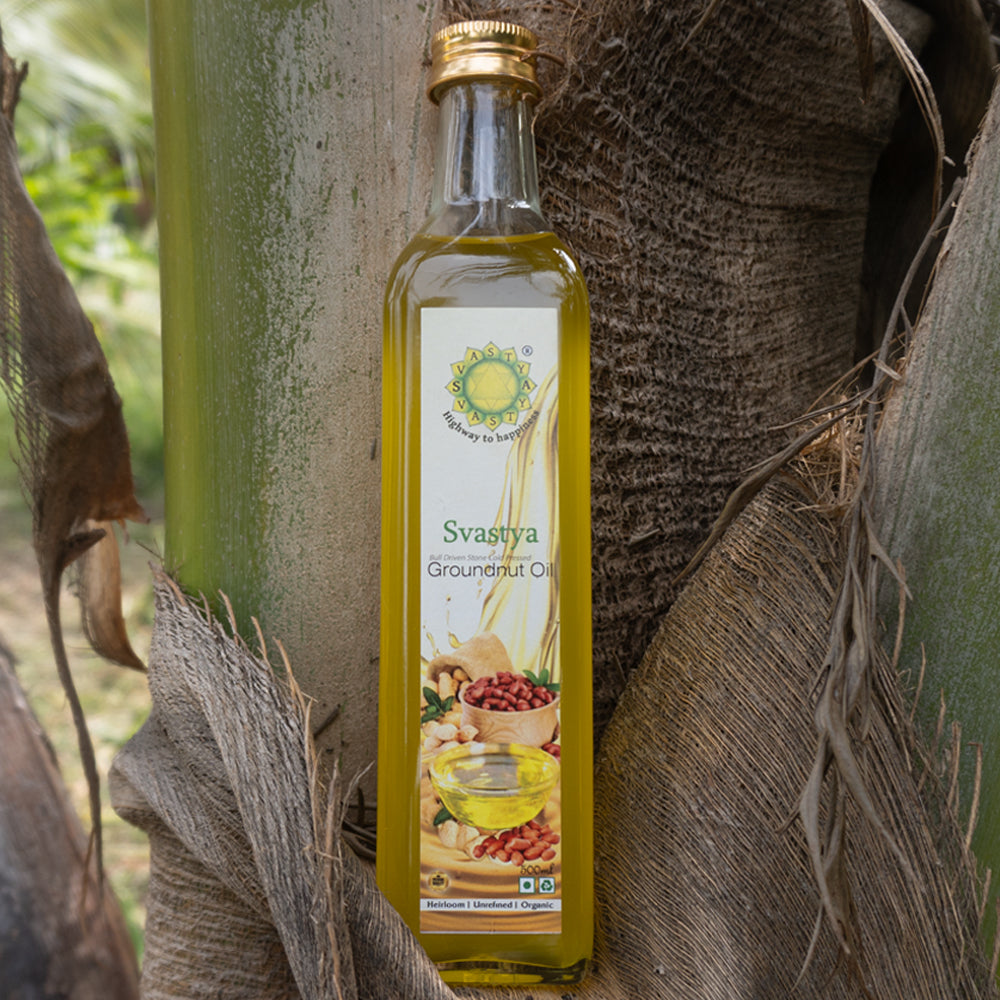
At Svastya Organic Farms, every bottle of our authentic cold pressed oil carries a production date, not just an expiry date — because we believe you deserve to know exactly how fresh your oil is. Explore our full range of traditional edible oils and discover what oil tastes like when nothing has been taken away.
FAQs: Shelf Life of Cold Pressed Oils
Q1. Why do authentic cold pressed oils expire faster than refined oils?
Cold pressed oils expire faster because they contain no synthetic preservatives, and their natural antioxidants — while effective — gradually deplete through normal oxidation. Refined oils are stabilised through multi-stage industrial processing and often contain added synthetic stabilisers like TBHQ. The shorter shelf life of cold pressed oils is a direct reflection of their purity, not their quality.
Q2. How can I increase the shelf life of cold pressed oils at home?
Store your oil in a cool, dark place — away from heat and direct sunlight. Always keep the bottle tightly sealed after use. Use dark glass bottles rather than plastic or clear glass. Buy in smaller quantities and track the production date. Refrigeration can also help extend freshness for highly unsaturated oils like flaxseed or walnut oil.
Q3. Are preservatives ever added to authentic cold pressed oils?
No — and the absence of preservatives is precisely what defines them. Genuine authentic cold pressed oils contain only the oil from the pressed seed or nut, with no synthetic additives, stabilisers, or preservatives of any kind. If a cold pressed oil lists any additive beyond the oil itself, it is not a truly authentic product.
Q4. How do I know if my cold pressed oil has gone rancid?
Your nose is your best tool. A rancid oil smells sharp, stale, metallic, or paint-like — distinctly unpleasant and nothing like the original seed it came from. It may also taste bitter or leave an acrid aftertaste. Natural cloudiness or sediment is not a sign of spoilage. A clean, seed-true aroma is always the best indicator that your oil is still at its best.